Paddling into the waves

February 6th, 2010

I wrote this on October 8, 2008, 10:51pm. It has been here waiting ever since. It has been long enough. -micah

Today I set out to understand myself. My peculiar mix of emotions and thoughts and attitudes – where does it come from? Whatever I am, it must be rooted in how I was when I was young.

So I thought back to what it was like to be 5 years old – running around like I was superman, in a world of simplicity and brightness. But even there, I recognized a theme. I distinctly remember feeling a sadness, an empathy for others, and for what I would now call the injury of innocence.

I had dreams when I was 5. In one of them, my mom had a flower in a clay pot, and she loved that flower dearly. My dad decided to do something nice for her, and sent it away to a place where they turned it into a mush, a kind of potpourri. He was trying to do something nice, but it broke her heart. She cried and cried.

I remember waking up and feeling so sad. I didn’t know whether it was real, but I was afraid of my dad. Not because of anything he had done, but because he caused such sadness.

Later on I would have dreams during which a young girl would get her hopes up that I would do something nice or fun for her, and she would be so thrilled. Then, when I wasn’t able to do what she was anticipation, she would cry. I would wake up sad.

In an earlier dream, I had a pet duck. And this duck had an outfit that matched mine. And when I was younger (so I dreamed), we had gone to church together in our matching outfits. We had been together since we were young. This duck had a nice environment to live in, but we would occasionally take him out of his cage, and let him walk outside. And in my dream, he flew away.

I was 5 years old. I cried for 5 days afterwards.

Where, I wondered, did this come from? My intense empathy, my bitter-sweet sense of other’s longings, my sadness at other’s innocent expectations disappointed?

I thought farther back. Several incidents occurred to me. My dad and I had been walking on the beach in Oregon one day (I would have been 3), and found a unique rock, full of holes. The holes went all the way through it, like a network of tunnels. In a special indentation, like a puzzle, a shell was fitted. I loved that rock. It was mine and dad’s, from a time I knew about, but couldn’t even remember.

One day, my brother climbed through my window, and knocked it to the ground, smashing it to pieces. I was heart-broken. I wanted to pick up the pieces and put it together again. I sketched a picture, trying to figure out how to get it back together.

Even earlier, I remember two incidences that were strangely similar. In one, my grandparents were visiting me in Oregon, and we were at a stream or river, playing in the water. Something floated by that caught my attention, and my grandparents told me to swim to get it. I tried, but the more I swam, the farther away it got. Finally, it drifted around the bend, and was gone.

I’m sure the sadness of a three-year-old boy paddling madly after something that is constantly slipping farther away is hard to grasp. Perhaps it will help to explain that somehow I perceived that object as special and beautiful just because my grandparents had sent me to get it.

The other event was at the ocean. Dad and I were walking along the beach, and throwing things into the waves. We saw a unique board floating in the water – and in some way it was special. Dad told me to swim after it, so I did. But the harder I swam, the farther away the board got, being carried over the crest of each wave farther out to sea. I wanted it, I longed for it, but my fear and powerlessness towards the ocean held me back. And so I swam, watching it drift farther from me, until it finally vanished.

Somehow, that memory has stuck with me, and the feeling of it has permeated me from top to bottom, coloring everything else I’ve ever done. When I look at the world, I see it through the shades of that longing. Every relationship is tinged with the sadness of my heavy touch on their light innocence.

Somehow, I think I will aways be that boy paddling desperately into the waves, watching as the thing he longs for slips farther and farther away.

Life, The Multiverse, and Everything

February 1st, 2010

I’m a big believer in the multiverse. I can’t quite explain why, but from the first time I heard the concept, I knew it was true. It just made deep, intuitive sense.

Sometimes I have trouble understanding why most people find it counter-intuitive and troubling, when it fills me with wonder and amazement. But I suppose that is to be expected. New discoveries are always problematic to the world in which they were born. The theory of relativity, the concepts of quantum mechanics, and the idea of the big bang all met with extreme mental resistance when they were introduced. But a generation or so later, most people understand and accept all of these ideas rather intuitively.

Most of us are a little behind on quantum physics, and very few of us have really been introduced to the concept of multiple universes co-existing. But in another generation, not only will these ideas be taken as intuitive, but these ideas will change the way people look at the world.

I can see a new mentality coming; one that rests in its understanding of the vastness of the multiverse, and in that light, lives differently. What I want to do, is to sketch out what that mentality will look like.

The vastness of reality

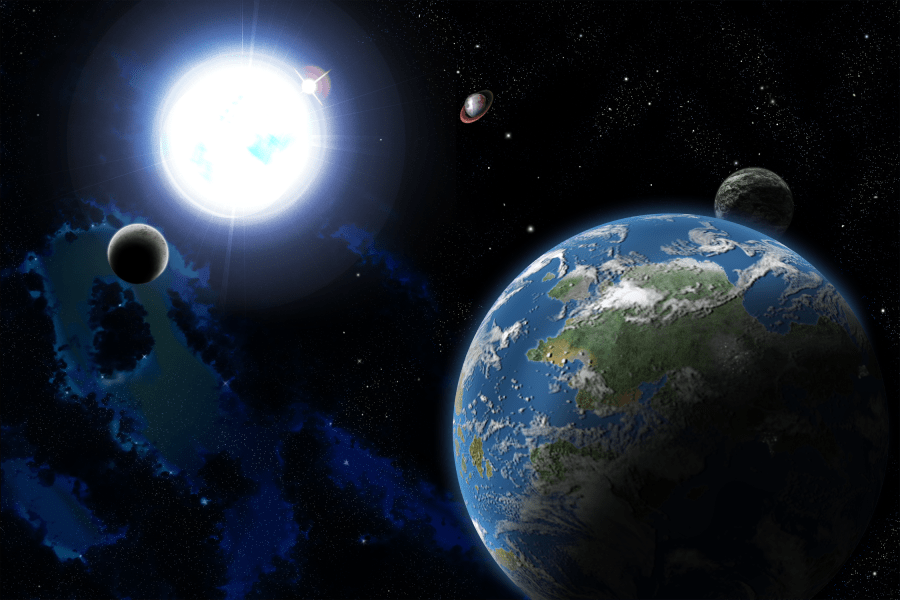
If Copernicus changed our viewpoint on the arrangement of the universe, the 20th century changed our understanding of the vastness of the universe. No longer is the earth or the solar system large in the scheme of things. Instead, we float on the outskirts of a vast galaxy, in a sea of galaxies just as unfathomable, in a universe that is nearly 20 billion light-years across.

Just ONE light-year is more than 5,878 billion miles in empty space, more than 65,000 times the distance from the earth to the Sun. So the width of our universe is the distance from the earth to the Sun times 65,000, times 20 billion. Sorry that those numbers don’t help much. We inevitably shrink our conception of reality due to our own lack of experience with things that big.

But, if you can, try to grasp the vastness of the universe for just a moment. Then turn your mind around and conceive of a beginning point from which everything sprang – not only our universe, not only every variation of our universe, but every variation of the very idea of universe itself. Every being that could ever exist, every world conceivable by human mind, every point throughout infinite space and time, not only exists, but exists in vastness so unfathomable as to stun the very sense of existence.

All that exists stretches so high above us; and when it reaches the top of our perception – it stretches for an infinity of worlds beyond.

The nature of existence

Throughout human history, the quiet debate has raged, asking:

Is the world caring, or heartless? Is it cruel, or gentle?

If the suffering in the world has encouraged many to label it violent and evil, the realization that we are small in the order of things has only intensified that perception. What has gone so largely unnoticed is that existence itself bends towards creation, proliferation, diversity.

A beautiful theology in the middle ages was called The Great Chain of Being. The idea was that God was loving, and a loving being all by himself is compelled to create something which it can love. But God, being all-loving, couldn’t just create one thing; instead, he created everything which can be loved, from the single-celled organisms which can fathom nothing, to humans who can contemplate their own existence, to beings of ever greater capability and complexity…the chain stretching all the way from nothingness up to very God himself. The concept was that if God was, then he was infinitely loving, and infinitely creative.

Unfortunately, the idea fell out of favor when it was realized there were gaps in the animal kingdom. The chain was apparently missing a few links, and so dropped out of the limelight.

But we now know that the chain does exist, and does stretch all the way from nothingness up to infinity, including in it every being which could ever be loved, in this universe or in any other. The nature of existence is creation, is giving life; and the primary thing which existence exists to do, is to give life to every being possible!

Things are sometimes hard, and suffering is real. But beneath it all is the great river of existence, giving life to everything which can be named, from here to infinity.

Living beyond choice and fate

For centuries, people have argued over free will and determinism. The most reasonable proponents of free will have admitted that the world is probably a mixture of the two, while most determinists have argued that the very concept of free will makes no sense. After all, everything in this world has a cause, and if we could know the cause fully enough, we could know with absolute certainty what would happen.

The advent of quantum physics shook up the balance a little, suggesting that not only are there things that seem to behave randomly, but there are things that are ultimately unknowable. Still, determinism held on strongly in both philosophy and science.

Contemplating life in the multiverse will require going beyond this dichotomy between free will and determinism. It turns out there is both choice and fate, and not in tension; in the multiverse determinism is precisely what gives rise to free will. Classical determinism supposed that there was one universe and one history, determined in a single line from beginning to end; the multiverse shows us that what is predetermined is the existence of every possibility, every history, every possible choice a person could make. And so the deterministic equations unroll, continually unleashing new possibilities and choices by the literal infinities.

A new sense of identity

Traditionally, a person’s sense of identity was held to be the one constant that remained unchanged throughout their life. But the past hundred years has challenged this significantly. From geographical mobility to the collision and diffusion of cultures, from the breakdown of racial divisions to the changing roles of people within society, from new theories of human origins to new understandings of the mind and the brain, people are faced with a more complex sense of identity than ever before.

We now understand that a person’s body is constantly changing its composition. We now understand that a mind is constantly changing too; and we’ve seen people with split brains, multiple personalities, and all kinds of conceptions of who they are.

There are two directions we can move. On the one hand, we can affirm that there is something at our core that is the true us, that is deeper than our bodies, our thoughts, and our emotions. We can shrink the boundaries of self to this perfect, shiny point; nothing that extends outwards from it is truly part of it. It is pure and alone. So we are ourselves, whether we lose hands or feet or skin cells or even memories; the center-point of self remains.

On the other hand, we can affirm that our self is messy and inclusive. We can extend the boundaries of our self to include the past versions of ourself, with our former perceptions and personality traits. We can extend the boundaries of our self to include future selves, and selves that could have been. We can extend the boundaries of our self to encompass the infinite branching tree of existence that starts at our creation, and stretches all the way to the end of time.

In the end, I think either direction brings us around to the same place. Much like seeing in 3D, our perception of self in the future will have to involve maintaining a dual focus on the central moment of awareness, and the vast expanse of what we ultimately encompass.

Kings and Heroes

January 27th, 2010

There is a lot of confusion about what exactly Jesus teaches us to be. Many people on TV would suggest that Jesus came to teach us how to be happy. There is a lot of validity to that thought, but somehow it seems a little shallow.

Other people suggest Jesus came to teach us how to be rich. Like Job’s friends, they suggest that your riches (or lack thereof) are a measure of your spiritual success. Some people would frame Jesus as offering us an “out” from this life, with the promise of something much better after we die. Still others would say Jesus teaches us to suffer.

To me, all of these ring hollow, or come off a bit masochistic. I would like to suggest another way of framing what Jesus teaches.

History consists of kings and heroes. The kings amass power, conquer enemies, build kingdoms, and enslave their rivals. They usually die at the hands of their power-hungry family members, or manage to survive into old age by killing off those who are perceived as threats. Heroes, on the other hand, usually revel in life. They hold onto things lightly, and pass freely between the comforts of luxury and the open fields. They make tough decisions, they sacrifice, they suffer excruciating pain so that the life of their family, their people, or their world will be changed. Heroes change, and they change the world around them. Heroes usually die in rescuing others, or live to old age, surrounded by the people they sacrificed for.

Conventional thinking attributes the greatness of society and civilization to the acts of kings. But when we look a little deeper, almost every great change in history has come from lone figures, moving against the grain of their society, changing the world around them as they went. Kings rewrite history to take the credit, but they never originate change. Change is the poison of kings.

Solomon can teach you to be a king, but he can’t teach you to be a hero. And while the rest of the world might envy being Solomon, Jesus told his followers that someone even greater than Solomon was among them. Someone who could enact real change in the world, someone who reveled in life, who could make the difficult decisions and sacrifices necessary to reshape the world.

He was a hero, and he taught them to be heroes.

every moment is valuable

January 24th, 2010

Every moment is valuable all by itself. But sometimes other moments help us see that.

At one point in my life I was extremely distressed. I walked out into the darkness, and eventually laid down behind an old log. And I wailed.

I couldn’t fathom why life was so terrible.

Years later, I wrote songs about that night. Those emotions were available to me, allowing me to create things that were new and amazing.

The funny thing about a song is that (if it’s a good one) there is nothing you would trade it for. Once that song exists, you would never want to go back and undo the experiences that lead up to it. No matter how bad those experiences were.

I feel the same way about that night. There is something there that I wouldn’t give up. Not because it turned into something positive – though that helps us see its value – but because in that moment itself, there was something worth its existence.

I think there’s a deeper beauty underneath the pain we encounter. I think it permeates our lives. And I think we can always see it if we look. Positive things may happen, but those things really only highlight what was there to begin with: the deep, underlying beauty in even our most painful moments.

converge

January 18th, 2010

Ever since I was 15, I’ve identified myself primarily as a songwriter. It is what I do, and who I am.

And ever since I began performing, I’ve begun segmenting myself. There is the side of me that performs and travels, and does ridiculous things in random midwestern states. There is the side of me that is introspective, that writes about the things I see, and tries to see the world differently. And there is the side of me that is all logic and precision and theology and politics and economics all blended together.

And it’s always a difficult thing to decide how much of each one I should share with the world.

As a musician, I’m expected to do things. Play big concerts, tour around the world, meet famous people, and maybe even cause a few international incidents along the way. Since I’m also a musician who writes songs, I’m perhaps expected to see things a little differently. But I don’t really think there’s any true cultural precedent for a musician who thinks critically about things.

This makes sense. We don’t turn to Bill O’Reilly to find music that stirs our souls, and we don’t turn to Fergie to learn about international politics. By and large, we want our public figures segmented into careful categories.

But I don’t think I’m really able to segment myself like that anymore. For me, thinking bold and interesting new thoughts, analyzing the political and religious and cultural messages I hear, having new insights about the world, writing music, and performing for others, all came meshed together. There is some kind of organic symbiotic relationship between all these aspects of my life. And every time I’ve tried to carefully box each segment up, they begin bleeding together, overrunning their barriers, and meeting in a confusing mess on the floor.

My main resolution this year is to do nothing I’m not passionate about. I think that means taking down some of the walls I’ve built. I think it means letting things converge.

I believe in convergence. Progress in technology is almost always about the convergence of previously unrelated things; lately, many people’s phones have become their computers. Blending styles has always been the way music has progressed; despite radio’s failures, we are the heirs of a broad and rich spectrum of musical influences, stretching back through centuries. The convergence of different ethnicities helped to make America great, and the convergence of science, art, philosophy, and religion sparked what came to be known as the Renaissance.

Convergence isn’t just a way to kick off new creative movements. It’s also the reality of humankind. We live in a rapidly converging world, where the actions of tribal people in remote parts of the earth deeply impact the lives of urban citizens in first-world countries. In the past, many would disregard the needs of strangers, expecting never to see those people again. Now, it is increasingly likely that the people who are strangers today will encounter you again and again, as neighbors, coworkers, or people you meet online. For humanity, all of our individual paths are converging.

There is something deep about reality, I think, that works to take all of its far-flung pieces, and bring them back together. Even as we diverge and diversify, our worlds collide. Even as the universe spreads outward, it becomes more interconnected.

So I am going to try to stop fighting. I’m going to try to let go of my struggle against gravity, and let all the pieces of my life turn and plummet back together. And we’ll see what happens.

One mind?

January 18th, 2010

Yesterday, it occurred to me how much of our human relationships are characterized by guilt or judgment. Guilt and being judgmental are two sides of the same blade, and that blade separates people into their own little self-focused domains.

For a moment I felt like I saw what it would be like to be free of these barriers. If you could really communicate fully with another human being – if you had no hesitation or self-consciousness in your interactions – wouldn’t it be like having the same mind?

We know that the human brain can function as different entities, if barriers are introduced. TV shows love to dwell on the weirdness of multiple personality disorders, or the functioning of split-brain patients. When communication between the two halves of someone’s brain is cut off, those two halves begin to function like different people. One hand may even fight the other hand for dominance.

If we can see a mind break into two different minds, doesn’t it stand to reason that two minds might, for just a moment, act as one? This synchronicity would probably only last briefly, a tenuously balanced moment in which time freezes and we step outside the barriers in which we’ve lived our entire lives.

I think this happens rarely, in fleeting moments, sometimes in young children, sometimes when someone looks face-on into another human being’s suffering, sometimes in music, when the musician for a moment feels connected to the floor and the audience and the sky itself. In that moment, judgment ceases, and the individual flexes and stretches out into a much bigger world.

3 things that have inspired me

October 24th, 2009

Just a short list of things that have inspired me to really feel life, even if only briefly.

A New Earth
…made me look at leaves differently, made me feel alive
http://eckharttolle.com/a_new_earth

The Inescapable Love of God
…begins theologically in depth, but ended making me feel the purpose of everything I experience
http://www.thomastalbott.com/the_inescapable_love_of_god.html

A video about deciding Who You Are
A PG-rated talk about focusing on your creative work, and not getting distracted by people selling stuff
http://www.43folders.com/2009/10/22/who-you-are

The last one is by no means as deep as the other stuff. But it is a video you can watch right this moment, and it inspired me to start writing a song tonight.

-micah

Living in the Cloud: Google Voice

July 28th, 2009

On a slight tangent, I just got accepted to beta test Google Voice. I definitely suggest putting your name on the invitation list. But how does this relate to living lightly?

Google Voice is a tool for centralizing phone numbers and voicemail. I’ve already centralized my phone in one way: by using a cellphone, and not having a home phone, life is streamlined.

But my voicemail and contact list has always been lacking. After all, I can only put so many contacts in my phone, and the list is not very user-friendly. I tend to forget about most voicemails, because they are inconvenient to check. Google Voice solves a lot of that.

Google Voice gives one phone number which can be routed to any phone. You can switch between phones at will, without changing your number, or needing to inform anyone of these changes. The one phone number always routes to you, wherever you direct it.

Better, Google Voice allows you to browse, organize, and listen to voicemails as if they were emails.

So, yesterday, I switched my cellphone voicemail over to Google Voice, following these instructions. Now, if you call my number and get no answer, you will be routed to Google Voice to leave a message. I also set up to make phone calls from my computer, without a phone, using this guide.

Which means I will probably be better at answering your messages. And I don’t have to worry as much about losing my phone. And I can switch service providers when I want. And I can check my voicemail online.

Which means I can go un-tethered more often.

Living in the Cloud

July 23rd, 2009

I want to start writing about a subject that fascinates me: how to live lightly.

This involves many things. For me, it ideally means

  1. Traveling with only one bag
  2. Carrying very few things in my pockets
  3. Not accumulating possessions
  4. Keeping all my data “in the cloud”, beyond the dangers of dropping laptops in swimming pools

These things may seem random, but the core idea is the same: I want to be able to travel, change direction at a moment’s notice, and live life without worrying about possessions or information.

I intend to document some of my thoughts and strategies in getting towards this goal. Right now, I’ll list a few of my inspirations.

-micah

The Greatest New Year’s Resolution Ever

January 5th, 2009

We’re setting out to accomplish our resolutions for the new year. And they’re going to be entirely different than anything you’ve ever seen.

The first problem with most resolutions is that they shoot too low. Lose 10 pounds, exercise a little, stop drinking so much egg-nog.

Nobody cares.

And so these resolutions are forgotten as quickly and lightly as they are made.

“Make no little plans. They have no magic to stir men’s blood.” (Daniel Burnham)

We’re going to do exactly the opposite of what people normally do. A small group of us has compiled a list of resolutions that are life-changing, world-shattering, and above all, BOLD. We are defying the forces of entropy and blandness, and are setting out to make a year that will reverberate with greatness.

The second problem with typical resolutions is that they aim to AVOID something, to hold out on eating that gingerbread man (maybe – hopefully – perhaps) until the month of February. By DEFINITION, these resolutions are broken almost as soon as they are made, as human willpower fails. By the time March rolls around, nothing of those pale resolutions is left.

By contrast, almost all of our resolutions are ACCOMPLISHMENTS, things we can go out and achieve, and once achieved, can never be taken from us.

The third problem with new year’s resolutions is that they’re personal and self-centered. Ours are exactly the opposite, resolutions born of a small group, but spreading and growing in their audacity and scope as they go, inviting and provoking ever more people to join in our great effort.

So we’re launching a new website and blog for this fantastic endeavor. And we want you to be a part of it. It’s called:

The Resolution Begins!